
The Architecture of Perception: How Our Words Build Our Worlds
When I first watched Arrival at fourteen years old, it completely blew my mind. The idea that language could actively inform how we think was something I had never considered - by design, I suppose. The language inside my head felt like a clean, transparent window through which I viewed an objective reality.
Years later, after devouring everything from cognitive science to dark fantasy, I’ve realized that window isn't clear at all. It is a deeply tinted, intricately etched lens.
We often treat language as a passive container for our thoughts, a set of labels we paste onto pre-existing things in the world. But what if the reverse is true? What if the tools we use to express reality are actually the scaffolding upon which our reality is built? From the clinical data of cognitive laboratories to the sweeping narratives of speculative fiction, a unsettling yet beautiful truth emerges: human beings have not inherited a single cognitive universe, but have constructed thousands of them. We are not merely truth-seekers describing a fixed world; we are architects of perception, constantly shaping and limiting what we can think.
P.S. I just rewatched Arrival (2016) this week after many, many years.
Relativity vs. Determinism
To understand how deeply language hooks into our biology, we have to look at how it directs our attention. In linguistics, this conversation anchors on the Sapir-Whorf Hypothesis. In short, linguistic determinism. It suggests that language acts as a cognitive cage, as in if you don't have a word for a concept, you are utterly incapable of conceiving it.
Modern cognitive science has largely discarded this ironclad view in favor of linguistic relativity. Language doesn't lock doors in our minds, but it heavily nudges us down specific hallways. It acts as an attentional training ground.
I first came across this concept through Lera Boroditsky's TED Talk - How Language Shapes the Way We Think. I highly recommend you check this out for some very interesting examples of linguistic determinism in different cultures.
She talks about the Kuuk Thaayorre community in Australia that doesn't use relative egocentric terms like "left" or "right." Instead, they rely entirely on absolute cardinal directions - north, south, east, west. To say "There's an ant on your leg," they might say, "There's an ant on your southwest leg." Because their grammar demands constant orientation, a Kuuk Thaayorre child possesses an internal compass that leaves the average English speaker completely disoriented. Their language forces a profound and constant awareness of their physical world.
We have been able to test this well with how we perceive colors. Russian speakers, for example, have distinct, mandatory words for light blue (goluboy) and dark blue (siniy). In laboratory settings, this grammatical distinction makes them measurably faster at visually distinguishing between these shades. The physical wavelengths of light hit everyone's retinas the same way, but the structural boundaries of language sharpen the mental image.
Similarly, the Himba tribe from Namibia does not have a word for Blue. For them, Blue is a variant of Green. When they were shown a color wheel in which one of the colors was Blue, they found it hard to distinguish between the greens and the blues. However, when people from England were shown the same color wheel, they were able to easily locate the Blue but did not easily distinguish the slightly different shade of green in a similar color wheel, that the people from the Himba tribe could. This video by Professor and Author of "The Story of Color" demonstrates how language can shape the way we see color.
Memory and Blame
This linguistic conditioning isn't just about color wheels or compass points; it dictates how we assign moral weight, memory, and blame as well.
In English, we are obsessed with agency. If a person accidentally bumps into a table and knocks over a vase, English speakers naturally default to an agentive construction: "John broke the vase." We assign an actor to the action, even when there was zero intent. Languages like Spanish or Japanese, however, structurally lean toward non-agentive framing for accidents: "The vase broke itself" (Se rompió el florero).
This structural quirk has radical cognitive consequences. In eye witness memory tests, when shown videos of accidental events, Spanish and Japanese speakers are significantly less likely to remember who caused the accident than English speakers are. It isn't a deficit of attention, it’s a reflection of grammatical priorities. Their language didn't train them to store the "offender" in their memory vault, whereas English speakers immediately lock onto a target for blame.
This reveals a fascinating piece of human nature. Just as we use cognitive biases to navigate uncomfortable realities, our languages provide a culturally sanctioned blueprint for how we process the world. We look at an accident and see a culprit to hold accountable; another culture looks at the same event and sees a natural closing of a state. Our very sense of justice and memory is bound to our syntax.
The Violence of Accumulation and Translation
If everyday grammar alters memory, then the historical clash of different languages shapes entire civilizations. Language is never an innocent, neutral artifact because it carries the weight of history, migration, and, frequently, violence.
In her dark fantasy novel Babel, R.F. Kuang illustrates this through a brilliant magic system powered by silver bars. The magic in Babel is generated entirely by what is "lost in translation". The precise, agonizing gap between what a word means in its original tongue and its closest equivalent in another. That unbridgeable remainder, the friction between two worldviews, becomes a literal source of geopolitical power.
[Source Word in Language A]  --->  ( The Conceptual Gap / Friction )  --->  [Target Word in Language B]
                                              │
                                              └───> [Where the Magic Happens]
Kuang uses this fantasy to lay bare a historical reality: language has always been a commodity, traded and stolen like spices or gold. English is not a pristine, self-contained system, it is a
Frankenstein vernacular, stuffed to the brim with foreign influences acquired through imperial dominance.
Consider how language reshapes the internal landscape of an entire nation. When Sanskrit traveled to China via Buddhist texts, it triggered a massive explosion of linguistic innovation. Core Chinese concepts for reality, ideas like hell, consciousness, and calamity, were deeply remade by Sanskrit imports. You cannot fully comprehend modern Chinese thought without untangling the historical threads of Buddhism.
But this cross-pollination rarely happens without friction. When a dominant culture assimilates the words of the marginalized, a quiet erasure occurs. As Kuang vividly notes, words and phrases you believe are carved into your very bones can disappear in no time when you are forced to adopt the tongue of an empire. The beauty of etymology cannot be separated from the historical violence that accompanied its collection.
The Medium of Language: Oral vs. Written Selves
The transformation of thought doesn't just stop at what words we use; it is fundamentally altered by how those words are preserved. The technology of language, the shift from speech to script, rewires our internal architecture.
In his short story "The Truth of Fact, the Truth of Feeling," Ted Chiang explores this cognitive chasm by contrasting oral cultures with written ones. We often assume literacy is a strict upgrade, a flawless technological advancement. But Chiang uncovers a deeper truth: oral and written cultures don't just store information differently; they create entirely different versions of the human identity.
The oral self is a living, adaptive thing. The written self is a document.
In a purely oral culture, memory is a fluid, living organism. It is communal, constantly negotiated, and adaptive. If a historical dispute arises, the community reconciles it in a way that serves the present social harmony. Truth is a matter of feeling and collective consensus.
The moment writing enters a society, it freezes a single version of events into concrete permanence. It detaches the word from the speaker, transforming dynamic human memory into a cold, unyielding fact. Neither system is inherently superior, but each breeds a completely different human being. The written word gives us precision and historical tracking, but it robs us of the organic adaptability that kept communities cohesive. The medium of our language determines whether we trust the living soul or the static document.
This short story 'The Truth of Fact, The Truth of Feeling' by Ted Chiang is a wonderfully thoughtful piece, and you, reader, are just the newest victim of my ongoing campaign to force everyone I meet to read it.
Collapsing the Circle: Stepping Outside of Time
If changing our medium shifts our relationship with history, what happens if we fundamentally alter our syntax? Can a radical change in language alter our relationship with physics itself?
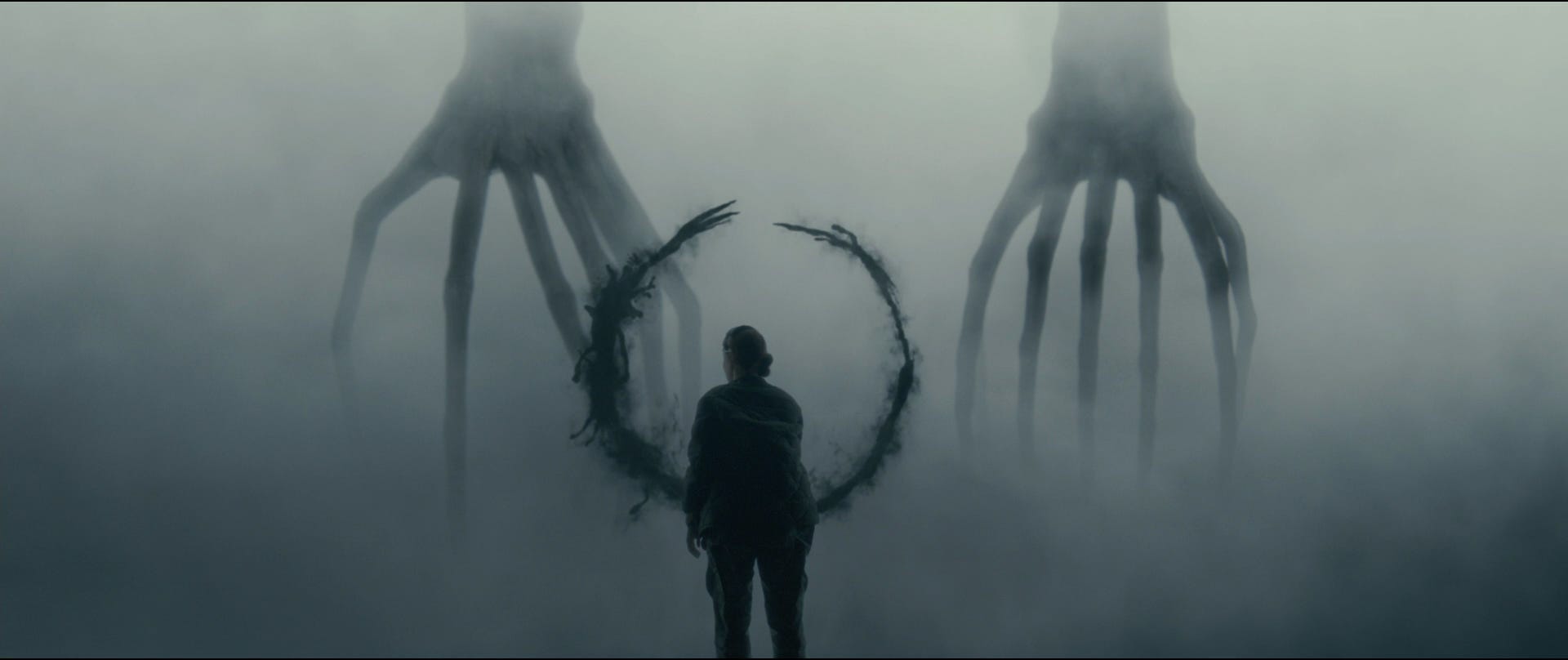
This is the poetic extreme of linguistic relativity explored in Denis Villeneuve’s Arrival (and Chiang’s "Story of Your Life"). When linguist Louise Banks is tasked with decoding the circular, non-linear script of the alien Heptapods, she isn't just learning a new vocabulary. She is absorbing a grammar that completely collapses time.
Our linear languages, built with a clear past, present, and future tense, force us to experience time like an arrow moving through space. The Heptapods' language, however, does not have a direction - it is simultaneous. As Louise internalizes this circular grammar, her brain rewires itself. She begins to experience her entire life, her past, her present, and her heartbreaking future, all at once.
While Arrival pushes the Sapir-Whorf hypothesis to a sci-fi extreme, it serves as a stunning metaphor for the real-world science. If a simple Russian word can alter how fast you see a color, or a Spanish phrase can change who you remember at a crime scene, then our languages are already altering our dimensions of reality. We are all living inside our own versions of a Heptapod script, viewing time and space through the syntactical limits passed down by our ancestors.
The 7,000 Experiments of Being Alive
We stand at a fascinating evolutionary crossroads. As globalization accelerates, languages are converging and disappearing at an unprecedented rate. We are narrowing our options, moving steadily toward a locally optimal linguistic solution for the sake of global efficiency. But in doing so, are we closing off vital windows into human consciousness?
Lera Boroditsky beautifully argued that the existence of 7,000 different languages represents 7,000 distinct experiments in making sense of being alive. Each tongue is a unique solution to the problem of human existence, a brilliant testament to the flexibility and ingenuity of the mind.
Realizing this makes the edges of my own thinking feel very fragile. If the language inside my head is quietly policing what I notice, dictating what I remember, deciding who I hold responsible, and anchoring me in time, then learning a new language is far more than a practical skill. It is an act of quiet rebellion against the limits of my own brain.
To open yourself up to another language is to unlock a whole new cognitive universe and, ultimately, to discover a entirely new version of yourself.